
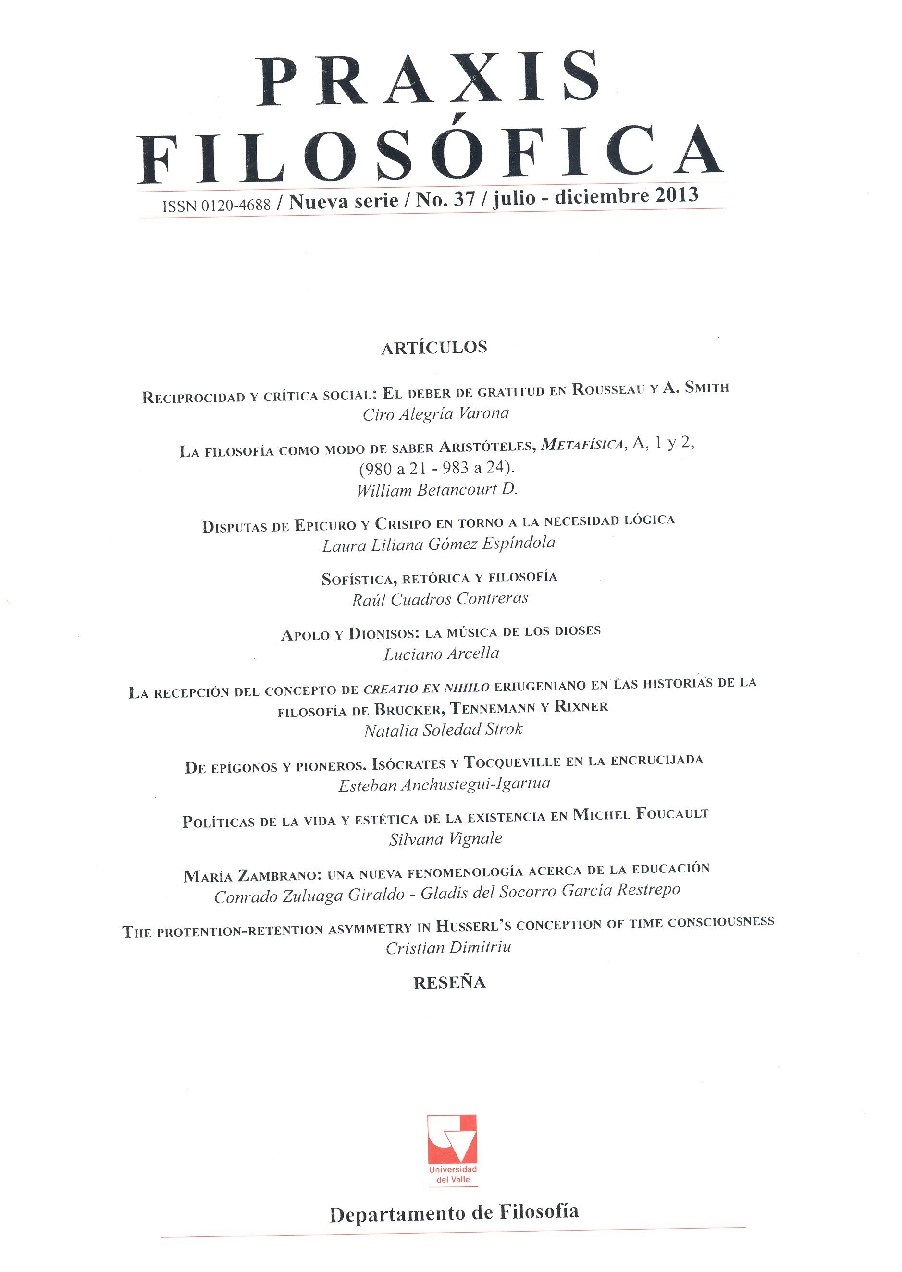
The reception of eriugena´s creatio ex nihilo in the histories of philosophy of Brucker, Tennemann and Rixner

Article Sidebar
Main Article Content
Christianity incorporates the creation out of nothing to break with the ancient concept of the eternal, uncreated world. Nevertheless, the philosophers from the first times of Christianity understand this creation in various ways. This article pretends to show the Eriugena’s (9th century) originality when understanding this formula, by making references to some of his sources. This paper will lead to an analysis of three histories of philosophy of modern times, which became sources for German idealism, regarding the presentation of this topic in Eriugena’s thought. The three historians of philosophy, belonging to different philosophical trends, are J. J. Brucker (1696-1770), W. G. Tennemann (1761-1819) and T. A. Rixner (1766-1838).
- Creation out of nothing
- creation out of nothing
- Eriugena
- history of philosophy
- History of philosophy
- reception
- Reception
- Neo-Platonism.
- Neo-Platonism
Agustín de Hipona (1957b): Del Génsis contra Maniqueos (De Genesi contra Manichaos), en Obras de San Agustín, Vol. XV. Madrid: BAC.
Beierwaltes, W. (1992): Pensare l’Uno, M. L. Gatti (trad.), Milán, Vita e Pensiero.
Brucker, J. J. (1975): Historia critica philosophiae, Hildesheim, Olms, vol. III.
Cappuyns, M. (1965) : “Le ‘De imagine’ de Grégorire de Nysse traduit par Jean Scot Érigène”, Recherches de théologie ancienne et médiévale 32, pp. 205–62.
Catana, L. (2005): “The Concept ‘System of Philosophy’: The Case of Jacob Brucker’s Historiography of Philosophy”, History and Theory 44 (1), pp. 72–90.
Dionisio Areopagita (2005): Los nombres divino, estudio preliminar, trad., y notas de Pablo Cavallero, Buenos Aires, Losada.
Gregorio Nysseno (1968): La creación del hombre (De hominis opificio), M. M. Bergadá (trad.), Buenos Aires, Centro de Estudios de Filosofía Medieval.
Harrison, P. (1999): The elements of pantheism: understanding the divinity in nature and the universe, Shaftesbury, Element.
Hegel, G. W. F. (1995): Lecciones sobre la historia de la filosofía, Volumen I, México D. F., Fondo de Cultura Económico.
Iohannis Scotti seu Eriugenae (1996): Periphyseon. Liber primus, E. Jeauneau (ed.), Turnhout, Brepols.
Iohannis Scotti seu Eriugenae (1999): Periphyseon. Liber tertius, E. Jeauneau (ed.), Turnhout, Brepols.
Isarael, J. (2008): Enlightenment contested: philosophy, modernity, and the emancipation of man, 1670–1752, Oxford, Oxford University Press.
Joannis Scoti Erigenae (1964 [1681] ): De divisione naturae libri quinque, div desiderati. Accedit appendix et Ambiguis S. Maximi Graece & Latine, Thomas Gale (ed.). Oxford, Theatro Sheldoniano, reimpresión fotográfica: Frankfurt am Main: Minerva.
Longo, M. (1979): “Le storie generali della filosofia in Germania”, en G. Santinello (ed.), Storia delle storie generali della filosofia. Vol 2: Dall’età cartesiana a Brucker, Brescia, La Scuola, pp. 329–635.
Ludueña, E. (2005): “Processio o oculti manifestatio en Escoto Eriúgena” en Actas de V Jornadas de Investigación en Filosofía, 9–11 de diciembre de 2004, La Plata. Recuperado de Revista de Filosofía y Teoría Política, Anexo 2005. http://www.memoria.fahce.unlp.edu.ar/trab_eventos/ev.108/ev.108.pdf.
Mario Victorino (2008) : “A Cándido, el arriano, en C. D’Amico (ed)”, Todo y nada de todo: selección de textos del neoplatonismo latino medieval, Buenos Aires, Winograd, pp. 39-43.
Micheli, G. (1995): “Wilhelm Gottlieb Tennemann (1761–1819)”, en G. Piaia (ed.), Storia delle storie generali della filosofia. Vol. 4/I: L’ età Hegeliana. La storiografia filosofica nell’area tedesca, Brescia, La Scuola, pp. 35–134.
Moran, D. (1989): The philosophy of John Scottus Eriugena: a study of idealism in the Middle Ages, Cambridge, UK, Cambridge University Press.
Piemonte, G. (1968): “Notas sobre la creatio de nihilo en Juan Escoto Eriúgena”. Sapientia, 23, pp. 37-58.
Rixner, T. A. (1823) Handbuch der Geschichte der Philosophie, Sulzbach, J.E. von Seidel Kunst– und Buchhandlung, volumen II.
Tennemann, W. G. (1798-1819): Geschichte der Philosophie, Leipzig, J. A. Barth,volumen VIII I.
Schneider, U. J. (1998): “Das Eklektizismus–Problem der Philosophiegeschichte”, en Schmidt–Biggemann, Stammen (eds), Jacob Brucker (1696–1770): Philosoph und Historiker der europaischen Aufklarung, Berlin, Akademie Verlag, pp. 135-58.
Downloads





This work is licensed under a Creative Commons Attribution-NonCommercial-ShareAlike 4.0 International License.
De acuerdo con nuestra política (Licencia Creative Commons CC BY-NC-SA 4.0) los artículos presentados y sometidos al proceso editorial en la revista Praxis Filosófica no tienen costo alguno para sus autores ni retribuciones económicas para la revista. El artículo de carácter inédito, producto de investigación o de algún proyecto que se presente a Praxis Filosófica, no podrá estar sometido a otro proceso de publicación durante el proceso que se lleve en nuestra revista.