
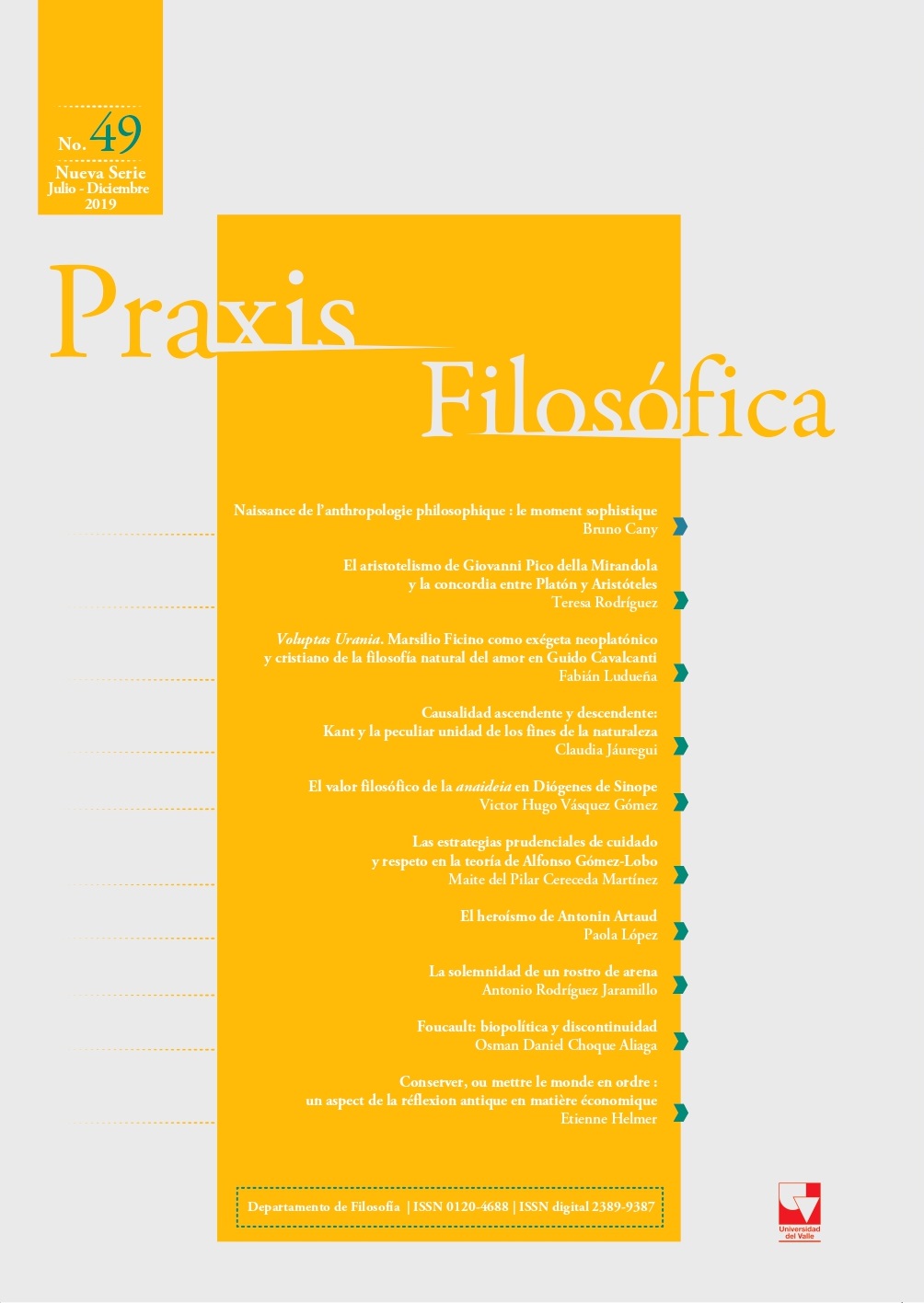
Voluptas Urania. Marsilio Ficino as a Neoplatonic and Christian Exegete of Guido Cavalcanti’s Natural Philosophy of Love

Article Sidebar
Main Article Content
The following article presents a study of Marsilio Ficino’s interpretation of the poem Donna me prega by Guido Cavalcanti. Through the examination of the ficinian exegesis, the text shows that, despite the presence of formal equivalent themes in both philosophers, Ficino’s analysis is based upon a theoretical breaking with Cavalcanti’s averroism. At the same time, Ficino produces a deep transformation of Cavalcanti’s philosophy of love in shifting its background from the heterosexual perspective of the dolce stil nuovo towards the platonic symposium of homoerotic ascendance. This movement goes side by side with an allegorical exegesis that Ficino proposes by means of references rooted in neoplatonism, Christian theology and natural magic. Regarding this last aspect, the figure of Zoroaster takes a fundamental prominence as a priscus theologus and guarantee of Ficino’s astral magic of love.
- Exegesis
- spiritus
- philosophy of love
- averroism
- natural magic
Downloads




Accepted 2019-05-29
Published 2019-07-15
De acuerdo con nuestra política (Licencia Creative Commons CC BY-NC-SA 4.0) los artículos presentados y sometidos al proceso editorial en la revista Praxis Filosófica no tienen costo alguno para sus autores ni retribuciones económicas para la revista. El artículo de carácter inédito, producto de investigación o de algún proyecto que se presente a Praxis Filosófica, no podrá estar sometido a otro proceso de publicación durante el proceso que se lleve en nuestra revista.