
Contenidos no- conceptuales en la filosofía de Kant

Barra lateral del artículo
Contenido principal del artículo
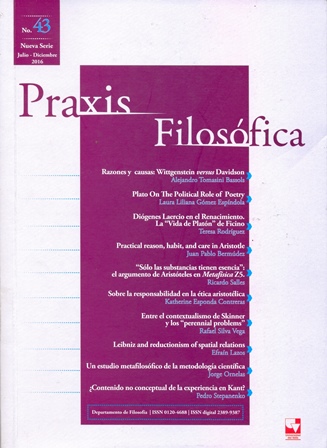
El objetivo de este artículo es contrastar dos maneras de entender ladiferencia y la colaboración de intuiciones y conceptos para responder ala pregunta de si tienen lugar los contenidos no-conceptuales de estadosmentales en la filosofía teórica de Kant. Estas dos maneras de entenderla relación entre intuiciones y conceptos en Kant son la que Efraín Lazossostiene en el primer capítulo de su libro Disonancias de la Crítica (2014,pp. 19-60) y la que yo he defendido en distintas publicaciones (2000,2008, 2011, 2012). De acuerdo con Lazos, las intuiciones para Kant tienencontenido no-conceptual. De acuerdo conmigo, las intuiciones para Kantsolo pueden representar algo, es decir, tener contenido, si están articuladasconceptualmente y, en este sentido, su contenido es siempre conceptual.
- intuiciones
- conceptos
- contenido mental
- filosofía teórica kantiana
- síntesis conceptual
Dretske, F. (1969). Seeing and Knowing. Chicago: Chicago University Press.
Guyer, P. (1987). Kant and the Claims of Knowledge. Cambridge: Cambridge University Press.
Hanna, R. (2005). Kant and Non-conceptual Content. European Journal of Philosophy13(2), 247-290
Heidegger, M. (1973). Kant und das Problem der Metaphysik (4ª edición). Frankfurt am Main: Klostermann.
Henrich, D. (1976). Identität und Objektivität. Heidelberg: Winter.
Kant, I. (1922). Kant ́s Briefwechsel II. En Kant ́s gesammelte Schriften, vol. XI. Berlín y Lepzig: Königlich Preussischen Akademie der Wissenschaften. (AA XI)
Kant, I. (1923). Logik, Physische Geographie, Pädagogik. En Kant ́s gesammelte Schriften, vol. IX. Berlín y Lepzig: Königlich Preussischen Akademie der Wissenschaften (AA IX)
Kant, I. (1924). Kant ́s handschriftlicher Nachlass III, Logik. En Kant ́s gesammelte Schriften, vol. XVI. Berlín y Lepzig: Königlich Preussischen Akademie der Wissenschaften. (AA XVI)
Kant, I. (1982). Kritik der reinen Vernunft. En Werkausgabe, vol. III y IV, ed. por W. Weischedel. Frankfurt am Main: Suhrkamp. (citado como A para la primera edición y B para la segunda).
Land, T. (2015). Nonconceptual Readings of Kant and the Transcendental Deduction. Kantian Review20(1), 25-51
Lazos, E. (2014). Disonancias de la Crítica. Variaciones sobre cuatro temas kantianos. Ciudad de México: Universidad Nacional Autónoma de México.
McDowell, J. (1994). Mind and World. Cambridge, Massachusetts: Harvard University Press.
Siegel, S. (2010). The Contents of Perception. En The Stanford Encyclopedia of Philosophy. Recuperado de http://plato.stanford.edu/archives/spr2015/entries/perception-contents/
Stepanenko, P. (2000). Categorías y autoconciencia. Antecedentes y objetivos de la deducción trascendental de las categorías. Ciudad de México: UNAM
Stepanenko, P. (2008). Unidad de la conciencia y objetividad. Ensayos sobre autoconciencia, subjetividady escepticismo en Kant. Ciudad de México: UNAM
Stepanenko, P. (2011). Introspection and Self-knowledge in Kant. Kant e-Print 6(1), 1-11
Stepanenko, P. (2012). Kant y la independencia epistémica del autoconocimiento. En Stepanenko, P. (compilador), La primera persona y sus percepciones. Mérida, Yucatán: UNAM, 79-87
Strawson, Peter, F. (1966). The Bounds of Sense: An Essay on Kant ́s Critique of Pure Reason. Londres: Methuen.
Descargas




De acuerdo con nuestra política (Licencia Creative Commons CC BY-NC-SA 4.0) los artículos presentados y sometidos al proceso editorial en la revista Praxis Filosófica no tienen costo alguno para sus autores ni retribuciones económicas para la revista. El artículo de carácter inédito, producto de investigación o de algún proyecto que se presente a Praxis Filosófica, no podrá estar sometido a otro proceso de publicación durante el proceso que se lleve en nuestra revista.