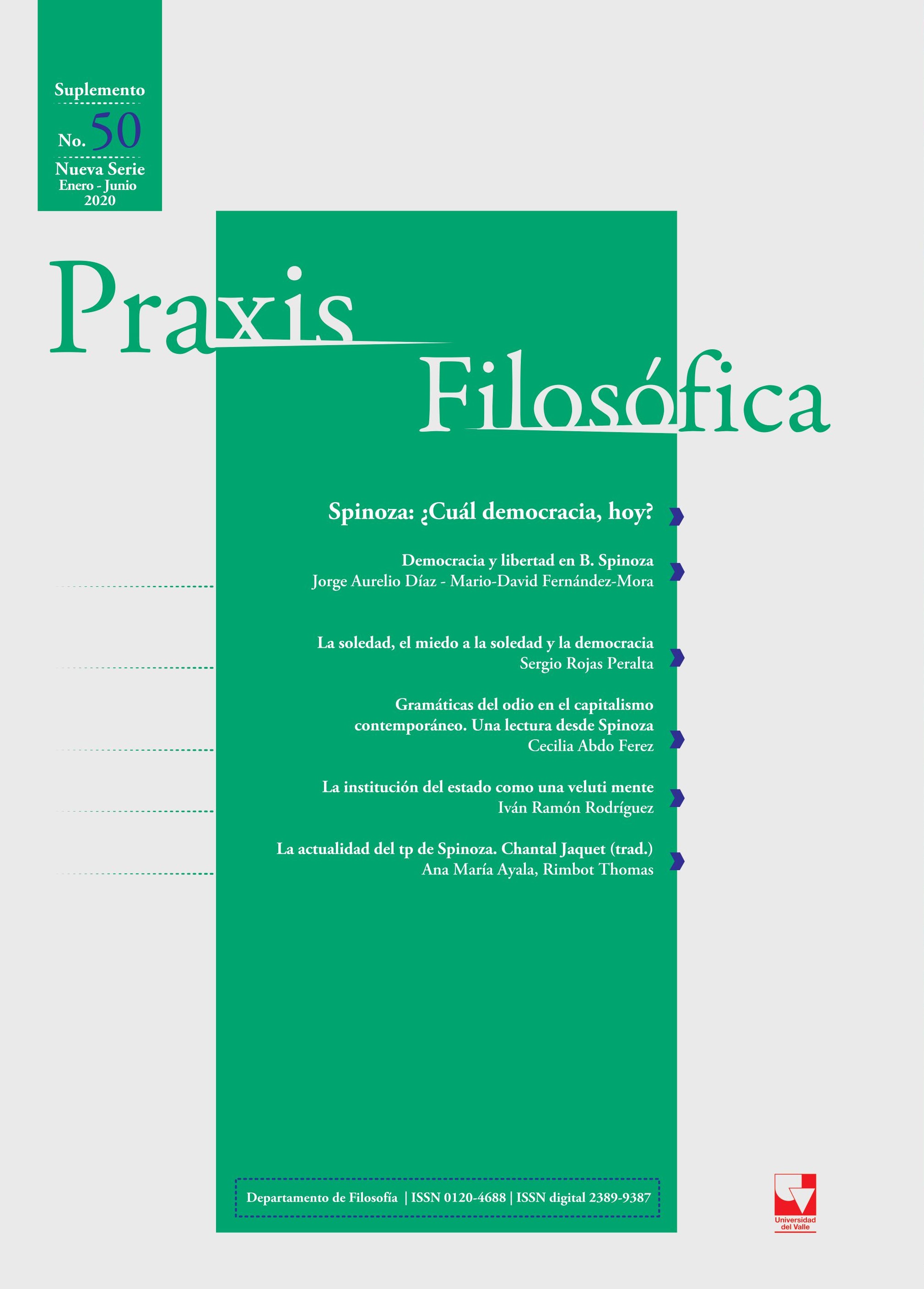
Democracy and Freedom According to B. Spinoza

Article Sidebar
Main Article Content
The negation of free will implies that a human being is by nature not free, unless he or she can become so by rightly using his or her intellect. If so, freedom would be a privilege reserved only for the “wise men”. Consequently, when Spinoza identifies democracy as the form of government that best defends human freedom, learned men become its sole beneficiaries. Therefore, the “common herd” is not protected because only fear or hope nudges the ordinary populace to follow the commands of reason, rather than rational thought. Could this undesirable consequence be what hindered Spinoza in the completion of his Political Treatise, just as he was prepared to study the nature of democracy?
- Politic
- Democracy
- Freedom
- Free Will
- Human nature
Downloads




Accepted 2020-02-11
Published 2020-04-15
De acuerdo con nuestra política (Licencia Creative Commons CC BY-NC-SA 4.0) los artículos presentados y sometidos al proceso editorial en la revista Praxis Filosófica no tienen costo alguno para sus autores ni retribuciones económicas para la revista. El artículo de carácter inédito, producto de investigación o de algún proyecto que se presente a Praxis Filosófica, no podrá estar sometido a otro proceso de publicación durante el proceso que se lleve en nuestra revista.