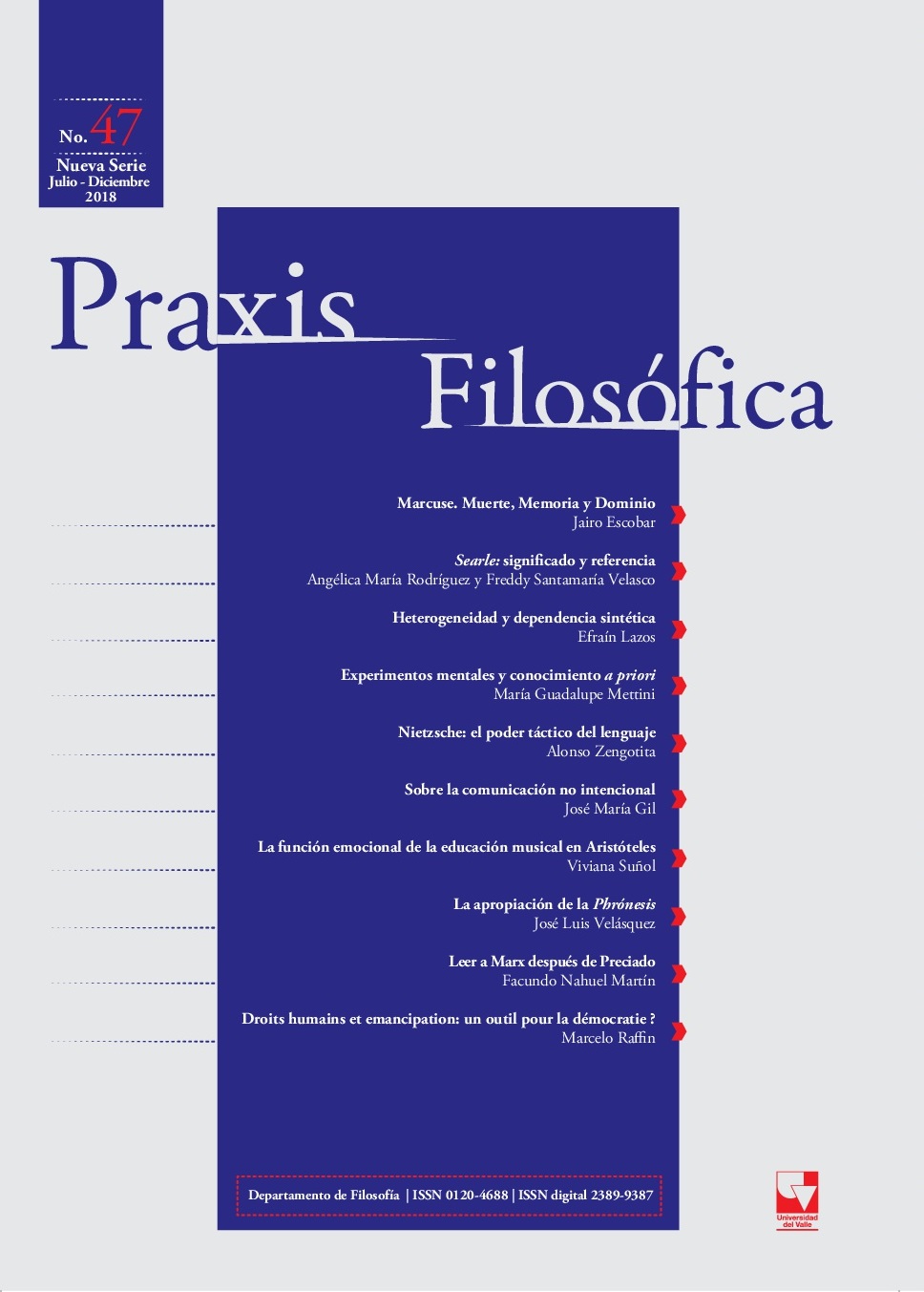
Thought Experiments and a priori Knowledge

Article Sidebar
Main Article Content
Although physicists have constantly used thought experiments, at least since the days of Galileo, the classical philosophers of science only recognized them purely heuristic -or, at most, critical- functions. However, some authors have defended the legitimacy of its use in the context of justification. In this vein, James Robert Brown argues for the thesis that the type of phenomenon that occurs in the so-called "Platonic thought experiments", provides a priori knowledge of the laws of nature. The purpose of this paper is to critically evaluate this perspective. It will attempt to show that the arguments to support the thesis of a priori knowledge in thought experiments has serious flaws and do not present sufficient reason to asume the metaphysical commitments to which it is linked.
- thought experiments
- a priori knowledge
- laws of nature
- phenomenon
- evidence
Armstrong, D. (1983). What is a Law of Nature? Cambridge: Cambridge University Press.
Bogen, J. y Woodward, J. (1988). Saving the Phenomena. The Philosophical Review, 97, 303-352.
Brown, J. R. (1991). The Laboratory of the Mind: Thought Experiments in the Natural Sciences. London: Routledge.
Brown, J. R. (1992). Why Empiricism Won't Work. Proceedings of the Biennial Meeting of the Philosophy of Science Association, 2, 271-279.
Brown, J. R. (1994). Smoke and Mirrors: How Science Reflects Reality. New York: Routledge.
Brown, J. R. (1996). Thought Experiments: A Platonic Account. En T. Horowitz. y G. Massey (Eds.), Thought Experiments in Science and Philosophy (pp. 119-128). Maryland: Rowman and Littlefield.
Brown, J. R. (2008). Philosophy of Mathematics: A Contemporary Introduction to the World of Proofs and Picture (2nd. ed). New York: Routlege.
Brown, J. R. (2011). The Laboratory of the Mind: Thought Experiments in the Natural Sciences (2nd. ed). London: Routledge.
Dretske, F. (1977). Laws of Nature. Philosophy of Science, 44, 248-268.
Galileo (1638). Discorsi e dimostrazione matematiche intorno a due nuove science. Leiden: Elsevier. (Traducción inglesa de Stillman Drake, Two New Sciences, Madison, University of Wisconsin Press, 1974)
Gödel, K. (1947). What is Cantor´s Continuum Problem? En P. Bencerraf y H. Putnam (Eds.), Philosophy of Mathematics: Selected Readings (2nd. ed., 1983) (pp. 470-485). New York: Cambridge University Press.
Häggqvist, S. (1996). Thought Experiments in Philosophy. Stockholm: Almqvist & Wiksell International.
Leibniz, G. (1969). A Brier Demonstration of a Notable Error of Descartes and Others Concerning a Natural Law. En L. Loemker (Ed.), Philosophical Papers and Letters (pp.296-302). Dordrecht: Kluwer Academic Publisher (Trabajo original publicado en 1648).
Mach, E. (1897). On Thought Experiments. En B. Mcguinness (Ed., 1976), Knowledge and Error (pp. 134-147). Dordrecht: Reidel.
McDonough, J. K. (2014). Leibniz's Philosophy of Physics. The Stanford Encyclopedia of Philosophy. Stanford: Stanford University. Recuperado de https://plato.stanford.edu/archives/spr2014/entries/leibniz-physics/
Norton, J. (1991). Thought Experiments in Einstein’s Work. En T. Horowitz y G. Massey (Eds.), Though Experiments in Science and Philosophy (pp.129-148). Maryland: Roward & Littefield.
Norton, J. (1996). Are Thought Experiments Just What You Thought? Canadian Journal of Philosophy, 26, 333-366.
Popper, K. (1959). The Logic of Scientific Discovery. London: Routledge. (Reimpreso en 2002).
Tooley, M. (1977). The Nature of Laws. Canadian Journal of Philosophy, 7, 667-698.
Downloads




Accepted 2018-06-18
Published 2018-07-15
De acuerdo con nuestra política (Licencia Creative Commons CC BY-NC-SA 4.0) los artículos presentados y sometidos al proceso editorial en la revista Praxis Filosófica no tienen costo alguno para sus autores ni retribuciones económicas para la revista. El artículo de carácter inédito, producto de investigación o de algún proyecto que se presente a Praxis Filosófica, no podrá estar sometido a otro proceso de publicación durante el proceso que se lleve en nuestra revista.