
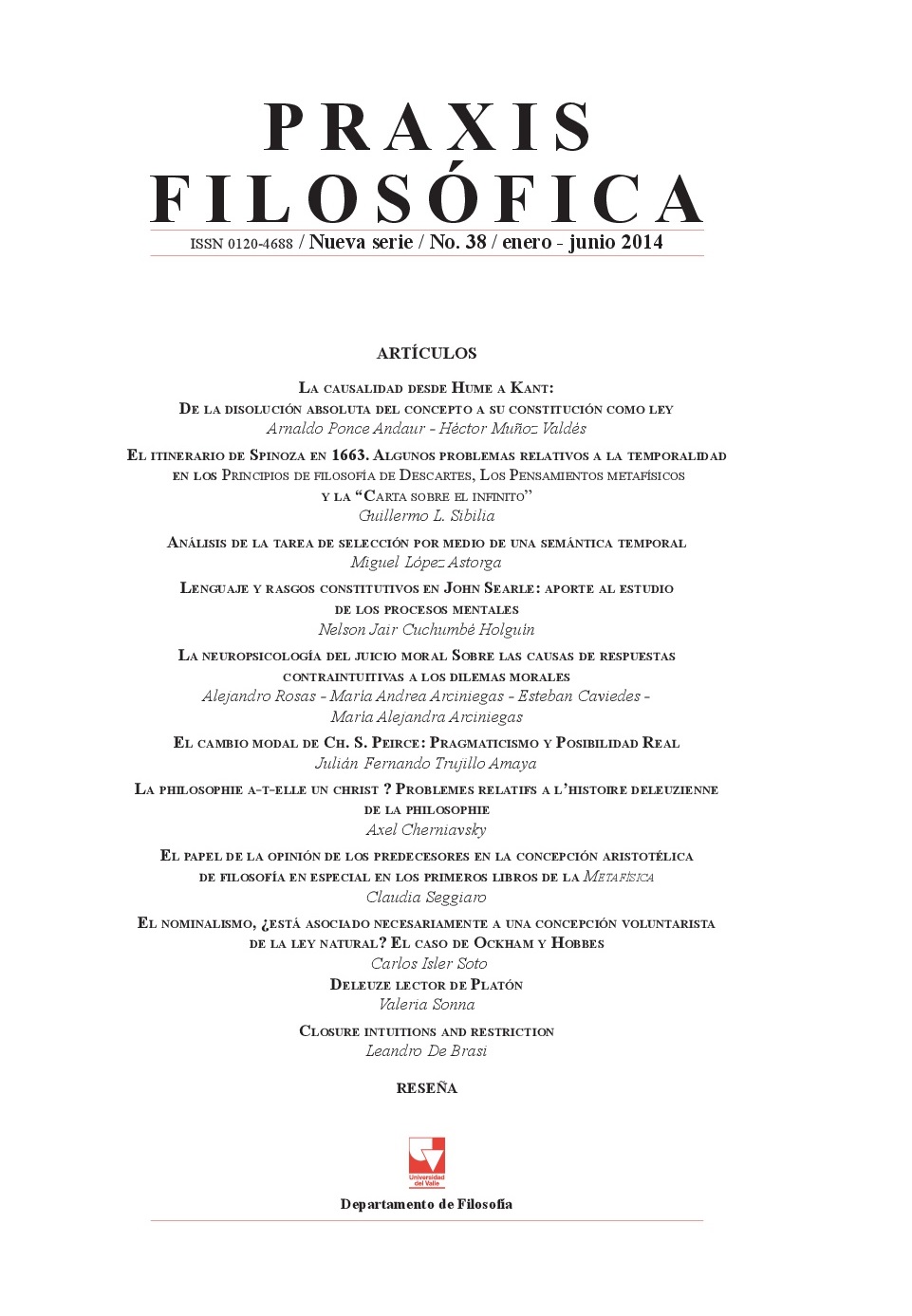
The role of the opinion of the predecessors in the aristotelian conception of philosophy, especially in the early books of the metaphysics

Article Sidebar
Main Article Content
In the second book of the Metaphysics (II 1, 993b, 11-15), speaking of research on the truth, Aristotle mentions the value of the contribution of their predecessors. There, Aristotle emphasizes that even those who have studied the nature of the things superficially have made a contribution in that search. In this book, the philosophy seems to be conceived as a cooperative task in which participates, somehow, the whole philosophical tradition. For this motive, in this paper, we attempt to explore around this conception of philosophy, emphasizing Aristotle’s use of the opinions of his predecessors. One of the notions on which we focus is éndoxa and the role that it plays in Aristotelian epistemology.
- Predecessors
- predecessors
- Conception of philosophy
- conception of philosophy
- Aristotle
- éndoxa
Berti, E. (2008a) [2000], Protreptico, Milano, UTET.
Boeri, M. (1993), Aristóteles, Física, libros I y II, Buenos Aires, Biblos.
Bywater, I. (1894), Aristotelis Ethica Nicomachea, Oxford, Clarendon Press.
Candel Sanmartín, M. (1988),Aristóteles, Analíticos Segundos, en Tratados de Lógica (Órganon), tomo II, Madrid, Gredos.
Calvo Martínez, T. (2007), Aristóteles, Metafísica, Madrid, Gredos.
Calvo Martínez, T. (2007), Aristóteles, Acerca del alma, Madrid, Gredos.
Echandía, G. (2007), Aristóteles, Física, Madrid, Gredos.
Fermani, A. (2008), Aristotele, le tre Etiche, Milano, Bompiani.
Natali C. (2009) [1999], Aristotele, Etica Nicomachea, Roma, Laterza
Ross, W. D. (1950), Aristotelis Physica, Oxford, Oxford University Press.
Ross, W. D. (1970) [1924], Aristotle’s Metaphysics, Oxford, Clarendon Press2 vols.
Wood, M. (2005) [1982], Aristotle, Eudemian Ethic. Book I, II, VIII, New York, Clarendon Press Oxford.
Zanatta, M. (2009), Aristotele,Metafisica, Milano, Biblioteca Universitaria Rizzoli.
Berti, E. (2005), Nuovi studi aristotelici, Brescia, Morcelliana.
Bolton, R., (1990), “The Epistemological Basis of Aristotelian Dialectic”, in Devereux, D. & Pellegrini, P. (ed), Biologie, logique et métaphysique chez Aristote, Paris, Editions Centre National de la Recherche Scientifique, pp. 185-236.
Brunschwig, J. (1990), “Remarques sur la communication de Robert Bolton, in Devereux, D. & Pellegrini, P. (ed), Biologie, logique et métaphysique chez Aristote, Paris, Editions Centre National de la Recherche Scientifique, pp. 237-262.
Cherniss, H.( 1935), Aristotle’s Criticism of Presocratic Philosophy, Baltimore, The Johns Hopkins Press.
Cardenas Mejía, L. G. (2011) Aristóteles: retórica, pasiones y persuasión, Bogota, San Pablo- Universidad de Antioquia
Crubellier, M. & Laks A. (2009), “Introduction”, in Crubellier, M. & Laks A (ed), Aristotle: Metaphysics Beta, Symposium Aristotelicum, Oxford, Oxford University Press, pp, 1-23.
Gadamer, H. G. (1995) [1999], El inicio de la filosofía occidental, trad. cast. de A. Gómez Ramos, Barcelona, Paidós.
Freeland, C. A. (1990) “Scientific Explanation and Empirical Data in Aristotle’s Meteorology”, Devereux, D. & Pellegrini, P. (ed), Biologie, logique et métaphysique chez Aristote, Paris, Editions Centre National de la Recherche Scientifique, pp. 287-320.
Irwin, T. (1988), Aristotle’s First Principles, Oxford, Clarendon Press.
Le blond, J. M. (1996), Logique et methode chez Aristote, Paris, Vrin.
Lucccheta, G. (2009), Metafisica I. La sophia degli antichi, Lanciano, Carabba.
Nussbaum, M. (2001) [1986], The fragility of Goodness, Cambridge, Cambridge University Press.
Owen, G.E.L. (1986), “Tithénai tà phainómena”, in Mansion, S. (ed.), Aristote et les problèmes ` de méthode ́, Paris, Louvain, pp. 83-103.
Stevenson J. G., “Aristotle as Historian of Philosophy”, in The Journal of Hellenic Studies, Vol. 94 (1974), pp. 138-143
Zucca, D. (2006), Essere, linguaggio, discorso. Aristotele filosofo dell’ordinario, Milano, Mimesis Edizioni.
Downloads





This work is licensed under a Creative Commons Attribution-NonCommercial-ShareAlike 4.0 International License.
De acuerdo con nuestra política (Licencia Creative Commons CC BY-NC-SA 4.0) los artículos presentados y sometidos al proceso editorial en la revista Praxis Filosófica no tienen costo alguno para sus autores ni retribuciones económicas para la revista. El artículo de carácter inédito, producto de investigación o de algún proyecto que se presente a Praxis Filosófica, no podrá estar sometido a otro proceso de publicación durante el proceso que se lleve en nuestra revista.