
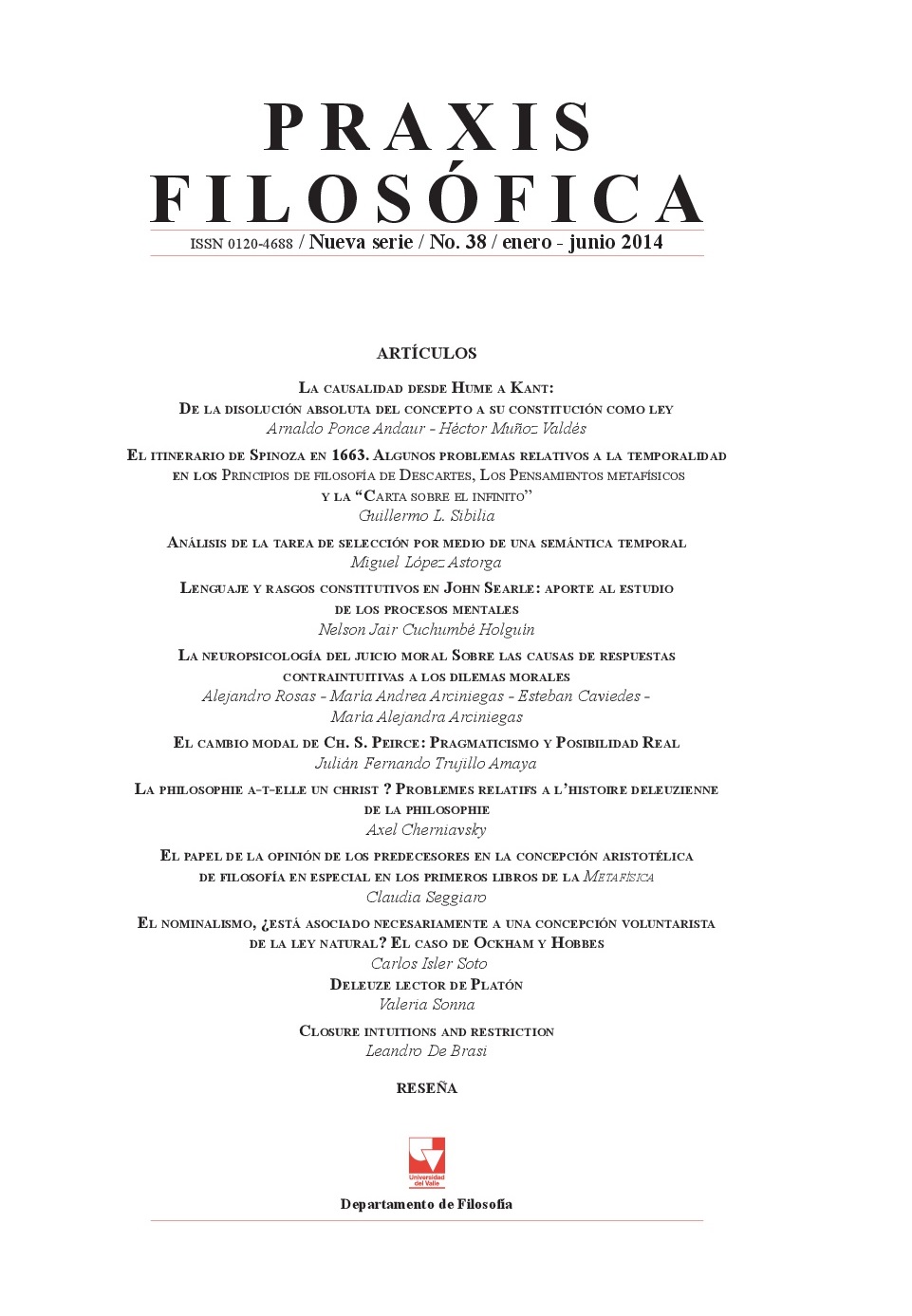
Does the philosophy have a christ ? problems related to the deleuzian history of philosophy

Article Sidebar
Main Article Content
Against the Hegelian conception of the history of philosophy as a succession of systems, Deleuze and Guattari suggest the idea of a coexistence of planes. That is because they are trying to avoid thinking the relation between the philosophies as an opposition, a refutation or a sublation, in order to build a frame which allows them appreciate the singularity of each philosophy. So why is it that afterwards they proclaim Spinoza “the Christ of philosophers”? Even the idea of a coexistence of planes, a coexistence of great philosophers, of true creators of concepts, does not suppose as well a selection, the constitution of a philosophic pantheon? The relation between the Hegelian and the Deleuzian history of philosophy will turn out to be much more complex than an opposition. In fact, it is possible to locate different historiographical models in Deleuze’s works, as well as in Hegel’s. Therefore, we will see the latter fluctuate in relation to the former depending on which historiographical model we take as a frame of reference.
- History
- history
- Teleology
- teleology
- Succession
- succession
- Contingency
- contingency
Badiou, A. (1997). Deleuze. “La clameur de l’Être”, Paris : Hachette.
Bergen, D. (2001). L’ontologie de Gilles Deleuze, Paris : L’Harmattan.
Bianco, G. (2005) : “Jean Hyppolite et Ferdinand Alquié”, dans S. Leclercq (éd.), Aux sources de la pensée de Gilles Deleuze 1, Mons-Paris, Sils María-Vrin, pp. 91-101.
Bouaniche, A. (2007). Gilles Deleuze. Une introduction, Paris : La Découverte.
Braudel, F. (1979). La Méditerranée et le monde méditerranéen à l’époque de Philippe II, Paris : Colin.
Braudel, F. (1985). La dynamique du capitalisme, Paris : Flammarion.
Brauer, D. (1998) : “La teoría hegeliana de la historia de la filosofía”, Cuadernos de filosofía, 44, pp. 9-21.
Deleuze, G. (1953). Empirisme et subjectivité, Paris : PUF.
Deleuze, G. (1962). Nietzsche et la philosophie, Paris : PUF.
Deleuze, G. (1968). Différence et répétition, Paris : PUF.
Deleuze, G. (1981). Spinoza. Philosophie pratique, Paris : Minuit.
Deleuze, G. (1990). Pourparlers, Paris : Minuit.
Deleuze, G. (1993). Critique et clinique, Paris : Minuit.
Deleuze, G. (2002). L’île déserte, Paris : Minuit.
Deleuze, G. (2003). Deux régimes de fous, Paris : Minuit.
Deleuze, G. & Guattari, F. (1972). L’anti-Œdipe. Capitalisme et Schizophrénie 1, Paris : Minuit.
Deleuze, G. & Guattari, F. (1991). Qu’est-ce que la philosophie?, Paris : Minuit.
Deleuze, G. & Parnet, C. (1977). Dialogues, Paris : Flammarion.
Ginoux, I. (2005) : “Platon”, dans S. Leclercq (éd.), Aux sources de la pensée de Gilles Deleuze 1, Mons-Paris, Sils Maria-Vrin, pp. 155-161.
Gueroult, M. (1979). Philosophie de l’histoire de la philosophie, Paris : Aubier.
Hegel, G. W. F. (1941). Phénoménologie de l’esprit, Paris : Aubier, t. II.
Hegel, G. W. F. (1959). Einleitung in die Geschichte der Philosophie, Hambourg: Johannes Hoffmeister.
Hegel, G. W. F. (1971a). Differenz des Fichte’schen und Schelling’schen Systems der Philosophie, Francfort-sur-le-Main : Suhrkamp.
Hegel, G. W. F. (1971b). Grundlinien der Philosophie des Rechts, Francfort-sur-le-Main : Suhrkamp.
Hyppolite, J. (1946). Genèse et structure de la Phénoménologie de l’esprit de Hegel, Paris : Aubier.
Macherey, P. (1990). Hegel ou Spinoza, Paris : La Découverte.
Mengue, Ph. (1994). Gilles Deleuze ou le système du multiple, Paris : Kimé.
Montebello, P. (2008). Deleuze. La passion de la pensée, Paris : Vrin.
Prado Jr., B. (1998) : “Sur le ‘plan d’immanence’”, dans É. Alliez (éd.), Gilles Deleuze. Une vie philosophique, Le Plessis-Robinson, Synthélabo.
Sartre, J.-P. (1985). Critique de la raison dialectique, Paris : Gallimard, t. I.
Wolff, F. (1992) : “Trios. Deleuze, Derrida, Foucault, historiens du platonisme”, dans B. Cassin (éd.), Nos Grecs et leurs modernes. Les stratégies contemporaines d’appropriation de l’Antiquité,Paris, Seuil, pp. 169-181.
Downloads





This work is licensed under a Creative Commons Attribution-NonCommercial-ShareAlike 4.0 International License.
De acuerdo con nuestra política (Licencia Creative Commons CC BY-NC-SA 4.0) los artículos presentados y sometidos al proceso editorial en la revista Praxis Filosófica no tienen costo alguno para sus autores ni retribuciones económicas para la revista. El artículo de carácter inédito, producto de investigación o de algún proyecto que se presente a Praxis Filosófica, no podrá estar sometido a otro proceso de publicación durante el proceso que se lleve en nuestra revista.