
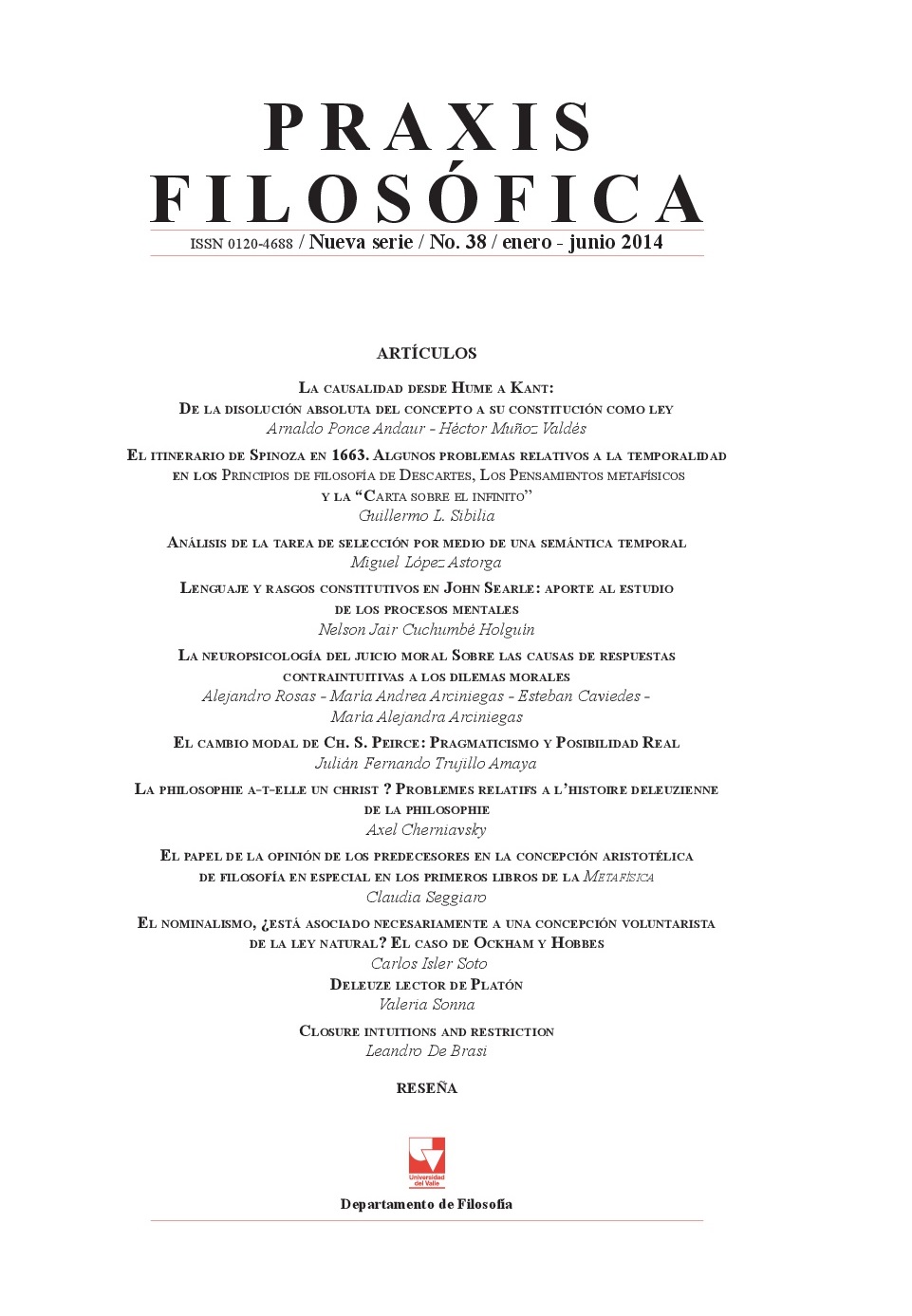
Spinoza’s itinerary in 1663. some problems related to temporality in the principles of cartesian philosophy, the metaphysical thoughts and the “letter on the infinite”

Article Sidebar
Main Article Content
The aim of this paper is to study some problems related to Spinoza’s doctrine of temporality, by focusing on the analysis of the Principles of Descartes’ philosophy, the Metaphysical Thoughts, and the “letter on the infinite”, all of them published in 1663. By doing this, we hope to show that Spinoza’s presentation of the concepts of time and duration in his work of 1663 –though it follows the Cartesian conceptualization– a surreptitious revision Works on it. This leads Spinoza’s thought to its definitive conceptual horizons, which will be explicitly defined in the letter 12. Accordingly, this paper also seeks to contribute to the study both of the status of the work of 1663 (Principles of Descartes’ philosophy and the Metaphysical Thoughts) and the meaning of Spinoza’s doctrine of temporality in this formative period of his thought.
- Duration
- duration
- Time
- time
- Infinite
- infinite
- Continuous
- continuous
- Mathematical physical science
- mathematical physical science
Bennett, J. (1994), “Descartes ́s Theory of Modality”, en The Philosophical Review, 103, 4, pp. 1-19.
Beyssade, J.-M. (1979), La Philosophie Première de Descartes, Paris: Flammarion.
Chauí, M. (1999), A nervura do real. Imanência e liberdade em Espinosa, Sao Paulo: Companhia das Letras.
Cottingham, J., (2008), Cartesian Reflections. Essays on Descartes ́s Philosophy, Oxford: Oxford University Press, pp. 348.
Cunning, D. (2010), Argument and Persuasion in Descartes ́s Meditations, Oxford: Oxford University Press, pp. 248.
Curley, E. (1978), Descartes against the skeptics, Mass., Harvard University Press.
Deleuze, G. (1996), Spinoza y el problema de la expresión, Barcelona: Muchnik Editores.
Descartes, R. (1965-1974), Œuvres de Descartes, publicadas por Charles Adam et Paul Tannery, Paris: Vrin.
Descartes, R. (1977), Meditaciones metafísicas, con Objeciones y respuestas, Madrid: Alfaguara.
Descartes, R. (1997), Los principios de la filosofía, Buenos Aires: Editorial Losada.
Frankfurt, H. G. (2009),Demons, Dreamers, and Madmen: The Defense of Reason in Descartes’s” Meditations”. Princeton University Press.
Gorham, G. (2008), “Cartesian temporal Atomism: a new defence, a new refutation”, British Journal for the History of Philosophy”, 16 (3), pp. 633-634.
Guèroult, M. (1953), Descartes selon l ́ordre des raisons, Tome I. L ́âme et Dieu, Paris: Aubier-Montaigne.
Guèroult, M. (1968), Spinoza I. Dieu, Paris: Aubier-Montaigne.
Israël, N. (2001), Spinoza. Le temps de la vigilance, Paris: Payot & Rivages.
Jelles, J. (1995), “Prefacio”, en: Dominguez, A., Biografías de Spinoza, Madrid: Alianza.
Jaquet, Ch. (1997), Sub specie aeternitatis. Étude des concepts de temps, durée et éternité chez Spinoza, Paris: Éditions Kimé.
Lecrivain, A. (1977), “Spinoza et la physique cartésienne”, en: Cahiers Spinoza, 1, Paris: Éditions Réplique, pp. 235-265.
Moreau, P.-F. (1994), Spinoza. L ́expérience et l ́éternité, Paris: Presses de l ́Université de Paris-Sorbonne.
Prelorentzos, Y. (1996). Temps, durée et éternité dans les Principes de la philosophie de Descartes de Spinoza, Paris: Presses de l ́Université de Paris-Sorbonne.
Rousset, B. (1994), “Spinoza, lecteur des Objections de Gassendi a Descartes: la métaphysique”, Archives de Philosophie, 57, pp. 485-502.
Spinoza, B. (1925, 1972), Spinoza opera, edición crítica de Gebhardt, C., Tomos 1-IV, Heidelberg: Carl Winter-Verlag.
Spinoza, B. (1988), Correspondencia, Madrid: Alianza.
Spinoza, B. (1990), Tratado Breve, Madrid: Alianza.
Spinoza, B. (2006), Principios de filosofía de Descartes / Pensamientos metafísicos, Madrid: Alianza.
Spinoza, B. (2009), Ética, Madrid: Trotta.
Wahl, J. (1920), Du role de lidée de l ́instant dans la philosophie de Descartes, Paris: Alcan.
Downloads





This work is licensed under a Creative Commons Attribution-NonCommercial-ShareAlike 4.0 International License.
De acuerdo con nuestra política (Licencia Creative Commons CC BY-NC-SA 4.0) los artículos presentados y sometidos al proceso editorial en la revista Praxis Filosófica no tienen costo alguno para sus autores ni retribuciones económicas para la revista. El artículo de carácter inédito, producto de investigación o de algún proyecto que se presente a Praxis Filosófica, no podrá estar sometido a otro proceso de publicación durante el proceso que se lleve en nuestra revista.