
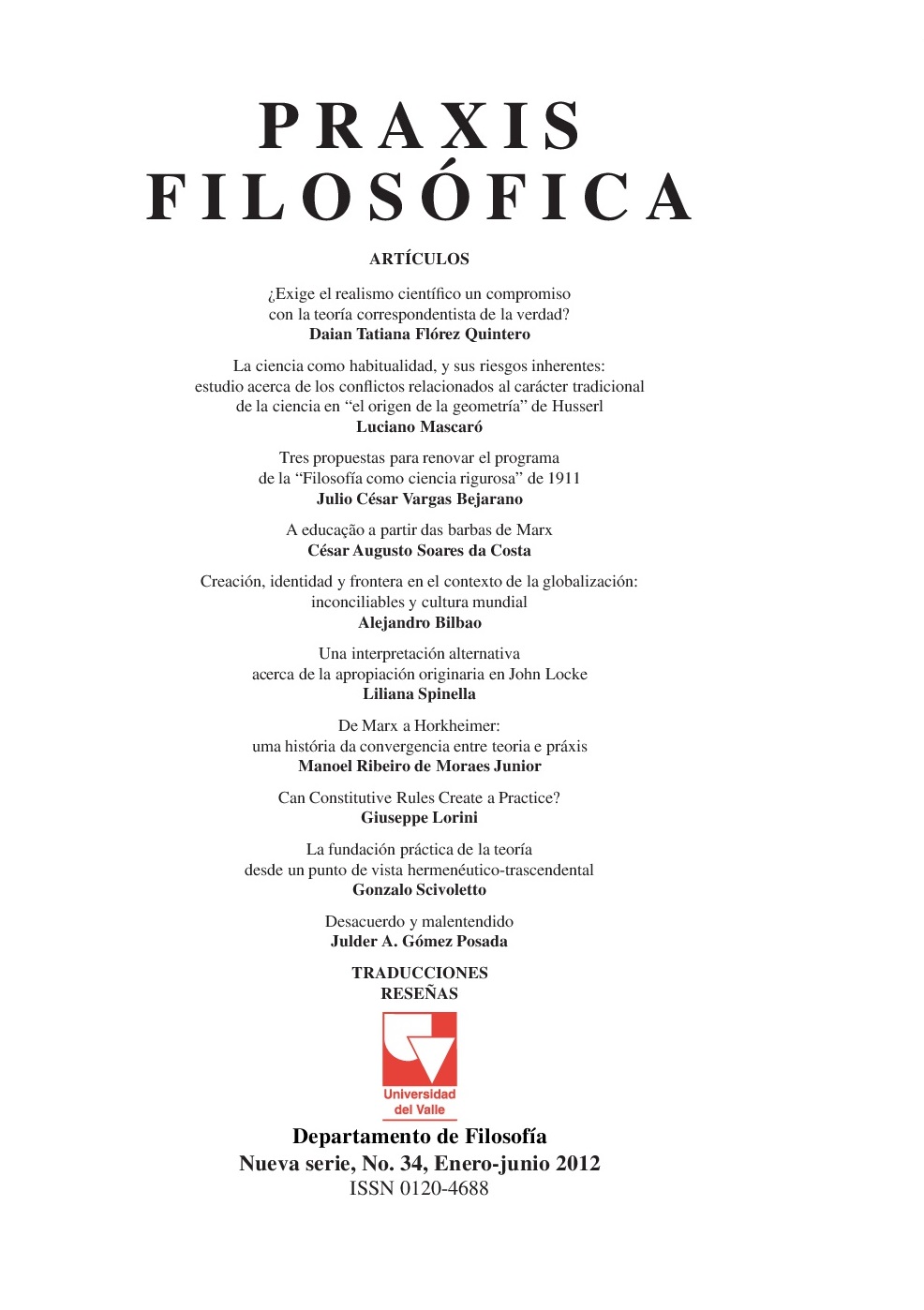
Three Proposals for the renovation of the program “Philosophy as rigorous science” from 1911

Article Sidebar
Main Article Content
In 2011, Husserl’s article “Philosophy as Rigorous Science” became one hundred years old. It states some key problems that should presently be answered by phenomenologists. The issues that will be discussed in this article are: (1) what is the motivation that leads to the epoché and what role do acts of willingness play in it; (2) to what extent is the expansión of consciousness a result of refl exive procedures, or in which way do unconscious processes infl uence it. A revision of the relationship between Phenomenology and Psychoanalysis is required in this part. (3) What is the sense of events and how do they relate to the growth or lessening of the Life-world. The consideration of the relationship between event and action requires reconsidering the question about the social responsibility of Philosophy. Finally, we consider how these problems affect the reformulation of Husserl’s philosophical program of 1911.
- Phenomenological reduction
- phenomenological reduction
- Epoché
- epoché
- Psychoanalysis
- psychoanalysis
- Unconscious
- unconscious
- Selfconsciousness
- selfconsciousness
- Events
- events
- Life-world
- Life-world.
Brudzinska, Jagna (2011). Die phänomenologische Erfahrung und dieFrage nach dem Unbewussten. Überlegungen im Anschluss an Husserl und Freud. En: Dieter Lohmar y Dirk Fonfara (eds.), Interdisziplinäre Perspektiven der Phänomenologie, 1–17. (2006) Springer, pp. 1-17.
Freud, Sigmund (2000). Die Traumdeutung.Studienausgabe. Bd. II. Fischer, Frankfurt a. M.
García-Baró, Miguel (2006). Del dolor, la verdad y el bien. Salamanca, Sígueme.
Heidegger, Martín (1988). Schelling: Von Wesen der menschlichen Freiheit. GA. 42. Vittorio Klostermann, Frankfurt a. M.
Husserl, Edmund (1954). Die Krisis der europäischen Wissenschaften und die transzendentale Phänomenologie. Hua VI, Den Haag: MartinusNijhoff. La crisis de las ciencias europeas y la fenomenología trascendental, 1991, Barcelona, Crítica.
Husserl, Edmund (1965). Analysen zur passiven Synthesis. Hua XI. Den Haag: Martinus Nijhoff.
Husserl, Edmund (1976). Ideen zu einer reinen Phänomenologie und phänomenologischen Philosophie. Hua III/1, citado como “Ideas I”. Traducción: Ideas relativas a una fenomenología pura y una fi losofía fenomenológica, 1986, México, F.C.E.
Husserl, Edmund (1980): Phantasie, Bildbewusstsein, Erinnerung. Zur Phänomenologie deranschaulichen Vergegenwärtigungen. Texte aus dem Nachlass (1898–1925). Hua XXIII. DenHaag, MartinusNijhoff.
Husserl, Edmund (1982). Investigaciones Lógicas. Volumen I y II. Madrid, Alianza.
Husserl, Edmund (1987). Aufsätze und Vorträge (1911-1921). Hua XXV. Hrsg. v. Th. Nenon und H.R. Sepp.
Husserl, Edmund (1993):Briefwechsel. Die Münchenen Phänomenologen. Bd. II. Dordrecht: Kluwer.
Husserl, Edmund (2002). Zur Phänomenologische Reduktion. Texte aus dem Nachlaß (1926-35). Hua XXXIV.
Husserl, Edmund (2003). Tranzendentaler Idealismus. Texte aus dem Nachlass (1908-1921), Hua XXXVI, Dordrecht, Kluwer, 2003.
Husserl, Edmund (2009). La filosofía como ciencia rigurosa. Madrid, Encuentro.
Lasker-Schüler, Else (1966). Dolor de mundo. En: Revista “Eco”, Tomo XIII/2-3, pp. 134-135.
Nietzsche, Frierich (1999). AlsosprachZarathustra. De Gruyter, Bd. 4. München. Traducción Así hablaba Zaratustra, 1983, Alianza, Madrid.
Poveda, Gabriel (2003). El antiguo ferrocarril de Caldas. En: DYNA, Año 70, Nro. 139, Medellín, pp. 1-10.
Richir, Marc (1992). Méditations phénomenologiques. J. Millon, Grenoble.
Ricoeur, Paul (1965). De l’interprétation. Essai sur Freud. Paris, Seuil.
Steiner, Georg (2008): El fi n de las humanidades. En: Periódico “El Heraldo”, Barranquilla. 29-07-08. También accesible en: http://popayancity.blogspot.com/2008/08/el-fi n-de-las-humanidades.html
Vargas Bejarano, Julio César (2011). Sobre el principio de investigación de la “Filosofía como Ciencia Estricta”. En: “Co-herencia”. Revista de Humanidades. Universidad EAFIT. Vol. 8 No. 15, pp. 89-111.
Volkening, Ernesto (1971). El paisaje mítico de la infancia (recordando a Proust). En: Revista Eco, Tomo XXIII/1-2, pp. 194-213.
Waldenfels, Bernhard (2002). Bruchlinien der Erfahrung. Frankfurt: Suhrkamp.
Waldenfels, Bernhard (2008). La experiencia radicalizada. En: Alfredo Rocha (ed.). La responsabilidad de pensar. Homenaje a Guillermo Hoyos Vásquez. Barranquilla. Ediciones Uninorte.
Downloads




De acuerdo con nuestra política (Licencia Creative Commons CC BY-NC-SA 4.0) los artículos presentados y sometidos al proceso editorial en la revista Praxis Filosófica no tienen costo alguno para sus autores ni retribuciones económicas para la revista. El artículo de carácter inédito, producto de investigación o de algún proyecto que se presente a Praxis Filosófica, no podrá estar sometido a otro proceso de publicación durante el proceso que se lleve en nuestra revista.