
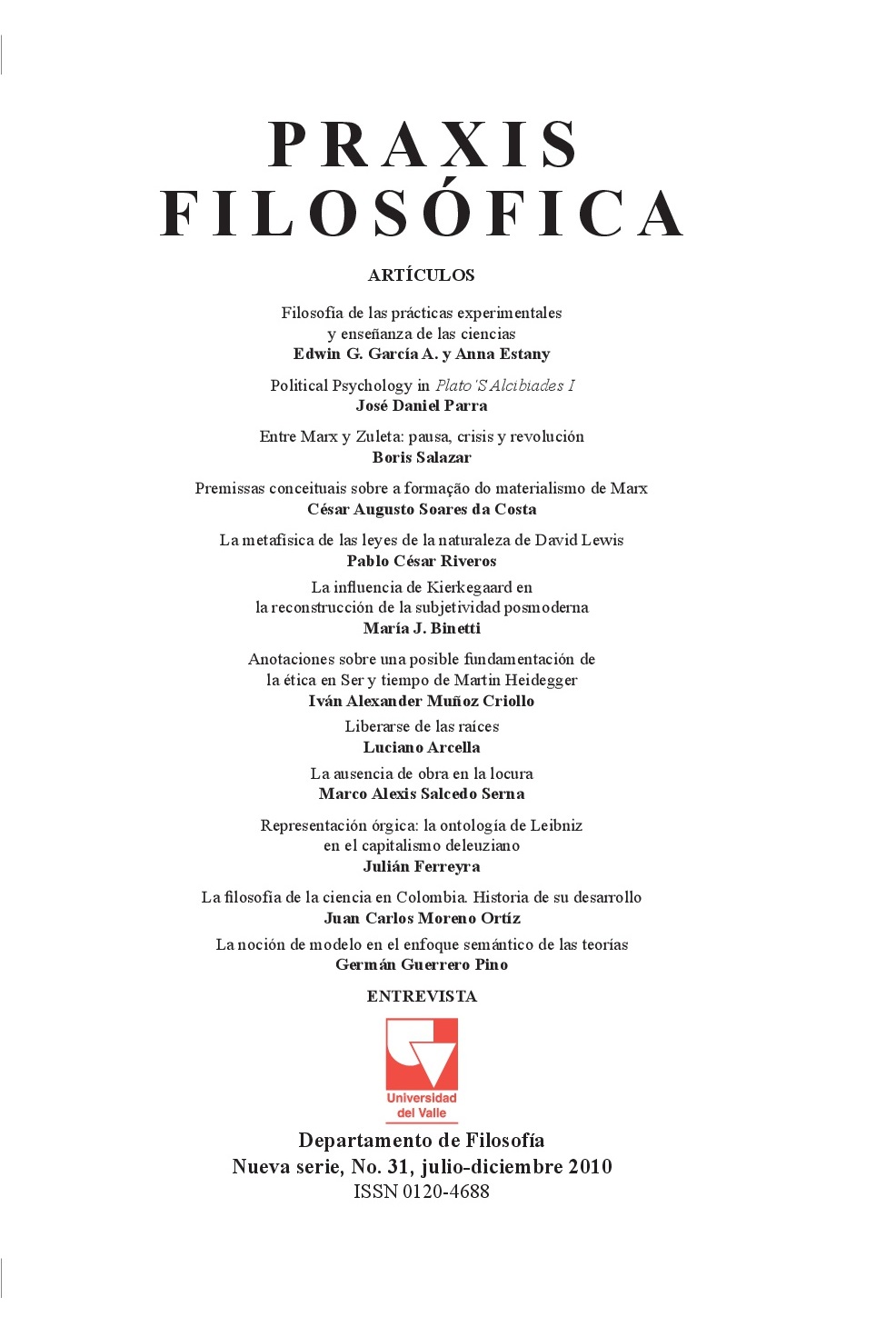
Orgiastic Representation: The Ontology of Leibniz in Deleuzian Capitalism

Article Sidebar
Main Article Content
This article aims to research the ontological thesis under the conception that Gilles Deleuze puts forward of capitalism, based on the links with the deleuzian reconstruction of the “baroque” philosophy of Leibniz as “orgiastic” representation. We will study a frst hypothesis: that the refolds of matter lead “naturally” to souls or monads as center of convergence, which role is to give a reason for the bodies and grant the unity of representation. Then we will question this hypothesis for taking for granted what it aims to demonstrate: the passage between bodies and souls. We will then present a second hypothesis, according to which the reason of the folds and pleats, of their convergence and their consistency, has its historical genesis; the suffcient reason would be the differential relation that constitutes the capitalism (dy / dx), produced by the random and contingency of universal history (the encounter of the liberated fux of work and the liberated fux of capital) and not, as Leibniz wanted it for the choice of God of “the best of all possible worlds”.
- Deleuze
- Lebiniz
- capitalism
- orgiastic representation
- fold
Ferreyra, J. (2010). Orgiastic Representation: The Ontology of Leibniz in Deleuzian Capitalism. Praxis Filosófica, (31), 137–158. https://doi.org/10.25100/pfilosofica.v0i31.3432
Downloads
Download data is not yet available.





This work is licensed under a Creative Commons Attribution-NonCommercial-ShareAlike 4.0 International License.
De acuerdo con nuestra política (Licencia Creative Commons CC BY-NC-SA 4.0) los artículos presentados y sometidos al proceso editorial en la revista Praxis Filosófica no tienen costo alguno para sus autores ni retribuciones económicas para la revista. El artículo de carácter inédito, producto de investigación o de algún proyecto que se presente a Praxis Filosófica, no podrá estar sometido a otro proceso de publicación durante el proceso que se lleve en nuestra revista.