
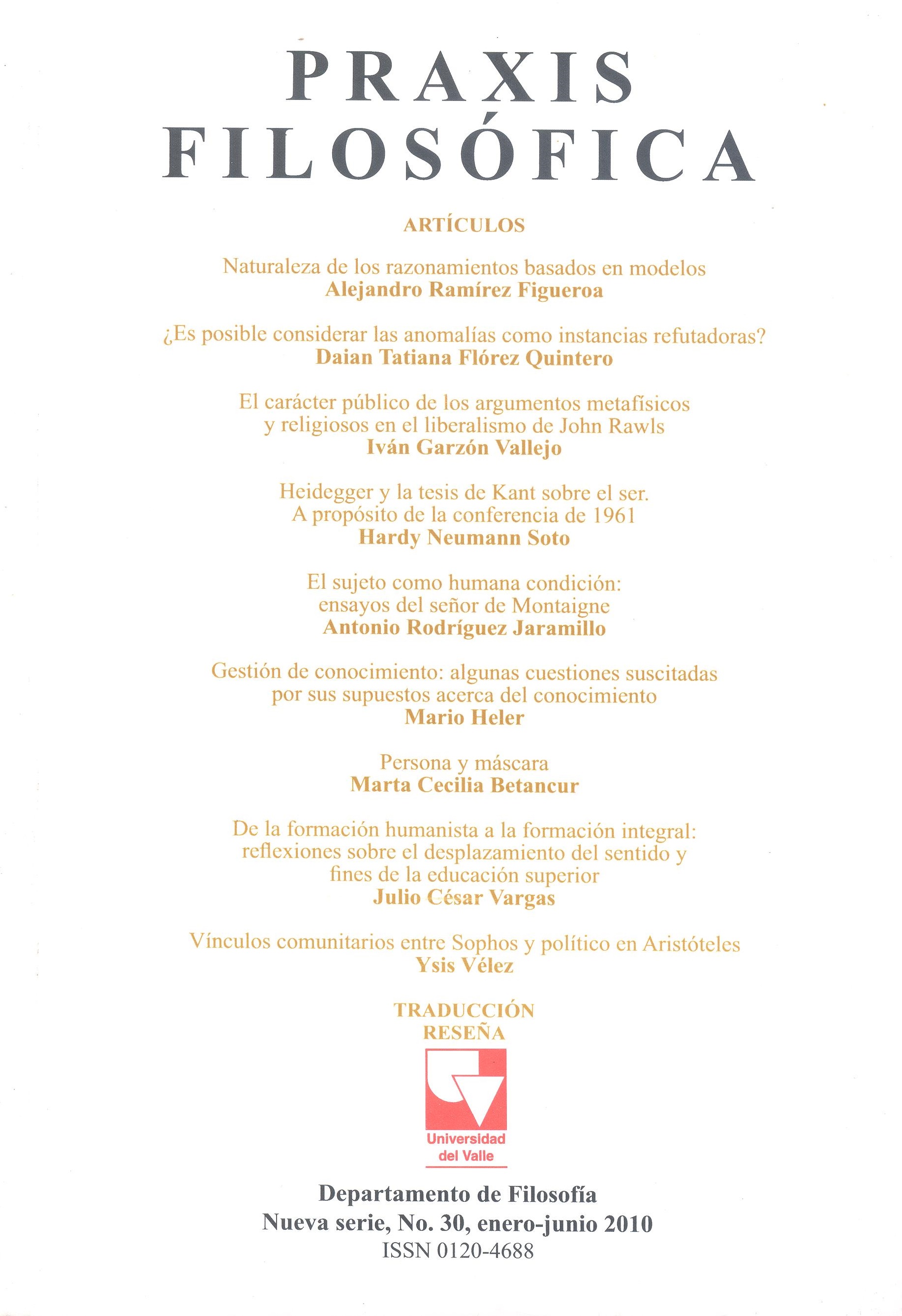
Can Anomalies Be Treated as Falsifying Instances?

Article Sidebar
Main Article Content
In his book Science and Subjectivity (1967) Israel Scheffler raises several criticisms against Kuhn´s theory of science. Among these criticisms, I would like to examine the accusation according to which, some of the notions that Kuhn rejects in his The Structure of Scientific Revolutions (hereafter SScR), such as the notion of “falsification”, reappear under new labels in other parts of this book. According to Scheffler, the notion of “falsification” reappears under the label of “anomaly”, “crisis” and “lack of faith”. In this paper, I intend to show that Scheffler’s main accusation is not well justified. To this purpose, I shall show that the notions of “falsification” and “anomaly” are not semantically equivalent. I shall motivate my position based on a contrast between these two notions, in the light of which I shall signal some of their more significant epistemological differences.
- Anomalies
- anomalies
- Falsification
- falsification
- Refuting instances
- refuting instances
- Semantic differences and epistemic differences
- semantic differences and epistemic differences.
García, C. E. (2006): Popper’s Theory of Science, London, Continuum.
Kuhn, T. (1962/1970): The Structure of Scientifi c Revolutions,Chicago, The University of Chicago Press, 1996.
Kuhn, T. (1977): Objectivity, Value Judgment, and Theory Choice. In: Introductory readings in the Philosophy of Science. Klemke (et al.) (ed). New York: Prometheus Books, 1998.
Popper, K. (1935/1959): La Lógica de la Investigación Científi ca, Madrid, Tecnos, 1982.
Scheffler, I. (1967): Science and Subjectivity,Indianapolis, Bobbs-Merrill Company.
Scheffler, I. (1972):“Vision and Revolution: A Postscript on Kuhn”, Philosophy of Science, Vol. 39, No 3, 1972, pp. 366-374.
Stone, M. (1991): “A kuhnian model of falsability”, British Journal of Philosophy of Science, 42, 1991.
Downloads





This work is licensed under a Creative Commons Attribution-NonCommercial-ShareAlike 4.0 International License.
De acuerdo con nuestra política (Licencia Creative Commons CC BY-NC-SA 4.0) los artículos presentados y sometidos al proceso editorial en la revista Praxis Filosófica no tienen costo alguno para sus autores ni retribuciones económicas para la revista. El artículo de carácter inédito, producto de investigación o de algún proyecto que se presente a Praxis Filosófica, no podrá estar sometido a otro proceso de publicación durante el proceso que se lleve en nuestra revista.