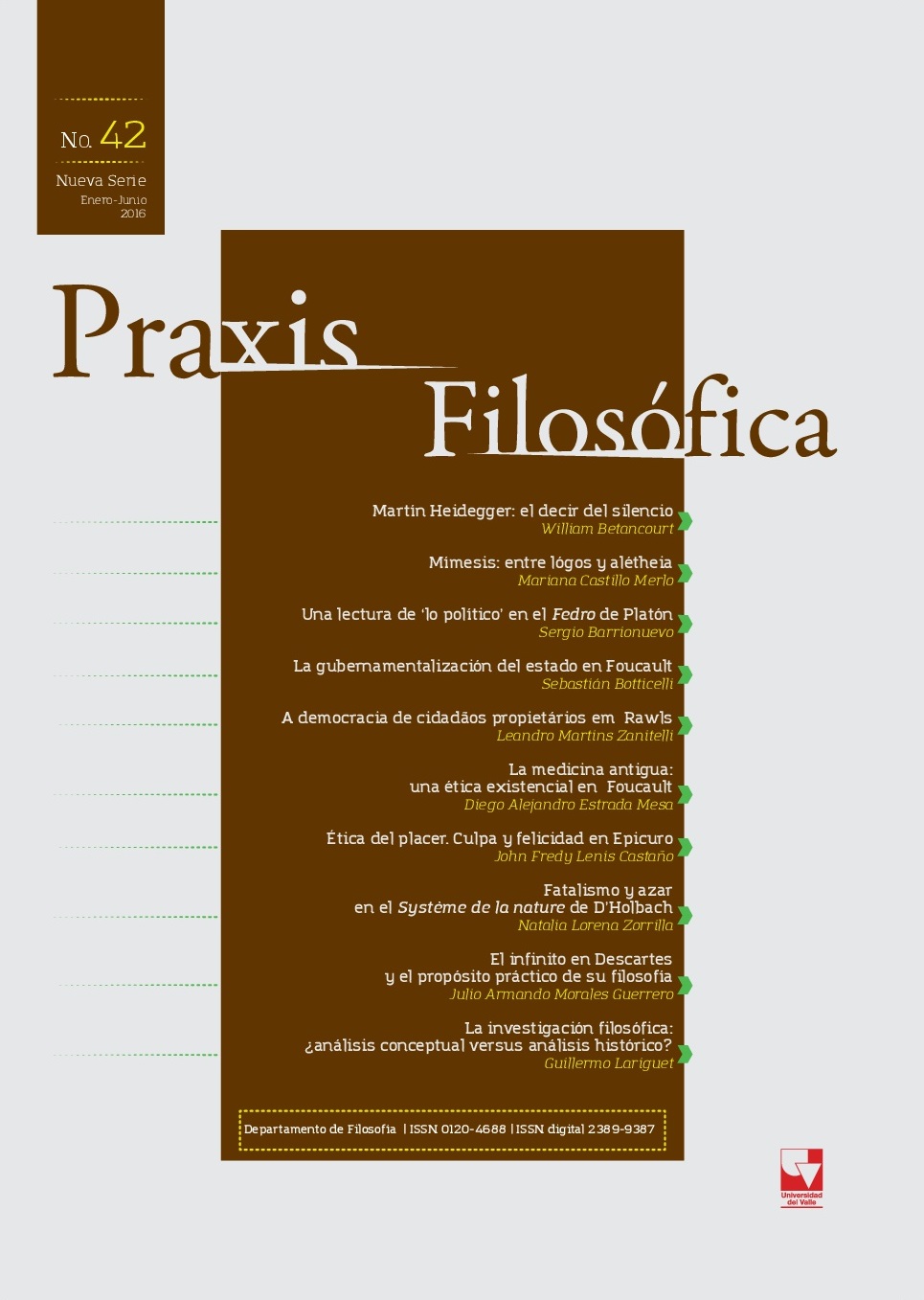
Infinity in Descartes and the practical purpose of his philosophy

Article Sidebar
Published:
Jan 15, 2016
Section
Articles
Main Article Content
Descartes’ concept of the infinite refers to the categories of substance and quantity; it’s different to modern mathematical theories of the continuum, related with quality. Cartesianism is based on an infinite which is God; the infinite supposes God and cogito is a consequence of God; this idea explains the world and its intelligibility. Human life is sui generis as goes by between the finite and the measureless infinite; also it is realized because necessity and freedom. This man’s vision takes Descartes to find out the truth with the practical purpose to live as well as possible.
- God
- infinite
- finite
- certainty
- moral doctrine.
Morales Guerrero, J. A. (2016). Infinity in Descartes and the practical purpose of his philosophy. Praxis Filosófica, (42), 203–217. https://doi.org/10.25100/pfilosofica.v0i42.3173
Downloads
Download data is not yet available.





This work is licensed under a Creative Commons Attribution-NonCommercial-ShareAlike 4.0 International License.
De acuerdo con nuestra política (Licencia Creative Commons CC BY-NC-SA 4.0) los artículos presentados y sometidos al proceso editorial en la revista Praxis Filosófica no tienen costo alguno para sus autores ni retribuciones económicas para la revista. El artículo de carácter inédito, producto de investigación o de algún proyecto que se presente a Praxis Filosófica, no podrá estar sometido a otro proceso de publicación durante el proceso que se lleve en nuestra revista.