
Kierkegaard on the problems of pure irony

Article Sidebar
Main Article Content
Søren Kierkegaard’s thesis, The Concept of Irony, contains an interestingcritique of pure irony. Kierkegaard’s critique turns on two main claims: a)pure irony is an incoherent and thus, unrealizable stance; b) the pursuit ofpure irony is morally enervating, psychologically destructive, and culminates in bondage to moods. In this essay, first I attempt to clarify Kierkegaard’sunderstanding of pure irony as “infinite absolute negativity”. Then I setforth his multilayered critique of pure irony. Finally, I consider briefly adistinctly theological component in Kierkegaard’s critique. I argue that thisfeature of Kierkegaard’s account can and should be distinguished from thebroadly ethical critique of pure irony that I sketch in the second section,even if these components of Kierkegaard’s position are found together as aunified whole in The Concept of Irony. My overall goal in this essay is toreveal the subtlety and plausibility of Kierkegaard’s critique of pure irony. Ialso attempt to disclose the richness of the Hegelian account of ethical life towhich Kierkegaard recurs in his thesis.
- Kierkegaard
- irony
- pure irony
- Sittlichkeit
- personal identity
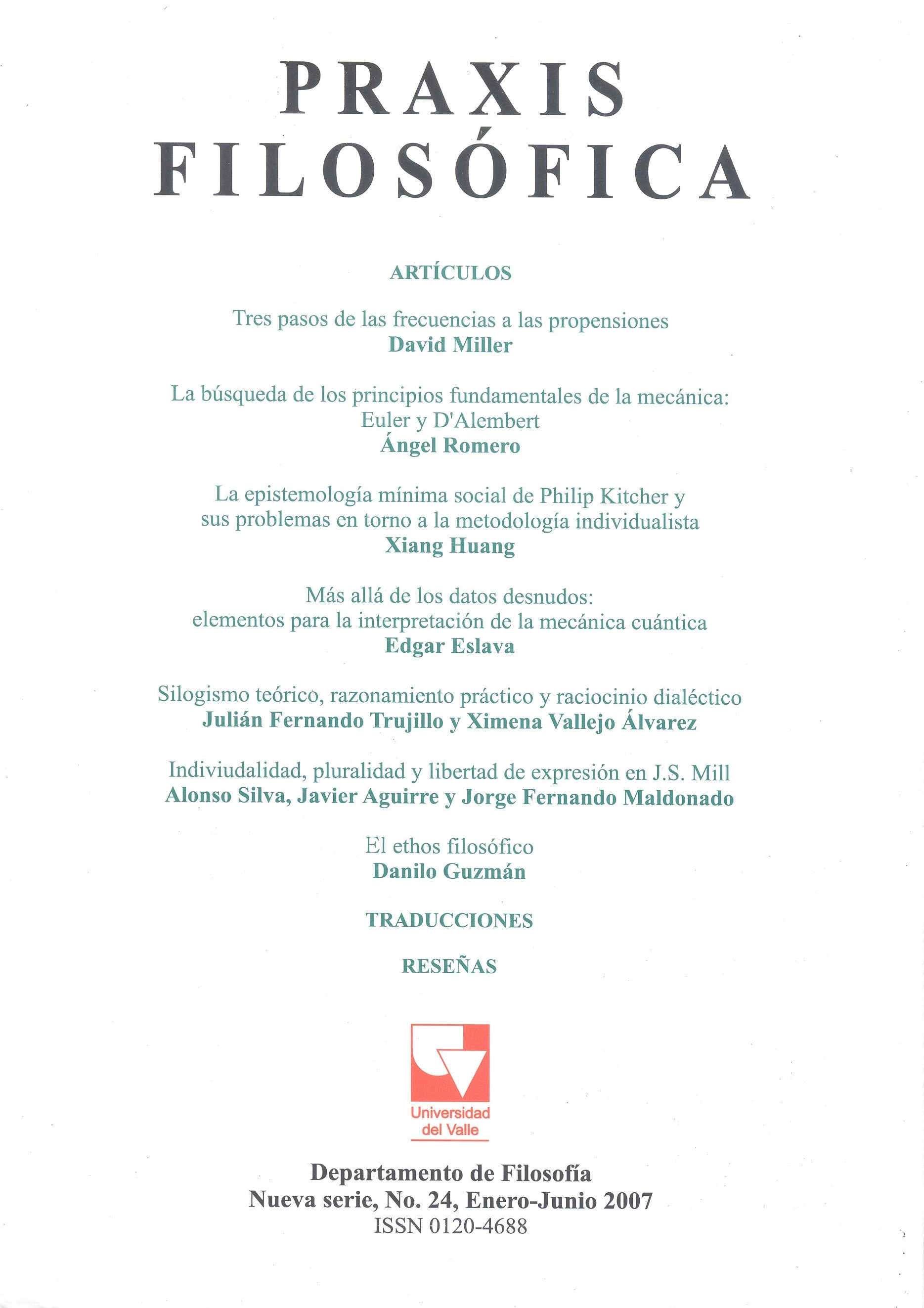
Hincapié Sánchez, J. (2007). Kierkegaard on the problems of pure irony. Praxis Filosófica, (24), 167–199. https://doi.org/10.25100/pfilosofica.v0i24.3138
Downloads
Download data is not yet available.





This work is licensed under a Creative Commons Attribution-NonCommercial-ShareAlike 4.0 International License.
De acuerdo con nuestra política (Licencia Creative Commons CC BY-NC-SA 4.0) los artículos presentados y sometidos al proceso editorial en la revista Praxis Filosófica no tienen costo alguno para sus autores ni retribuciones económicas para la revista. El artículo de carácter inédito, producto de investigación o de algún proyecto que se presente a Praxis Filosófica, no podrá estar sometido a otro proceso de publicación durante el proceso que se lleve en nuestra revista.