
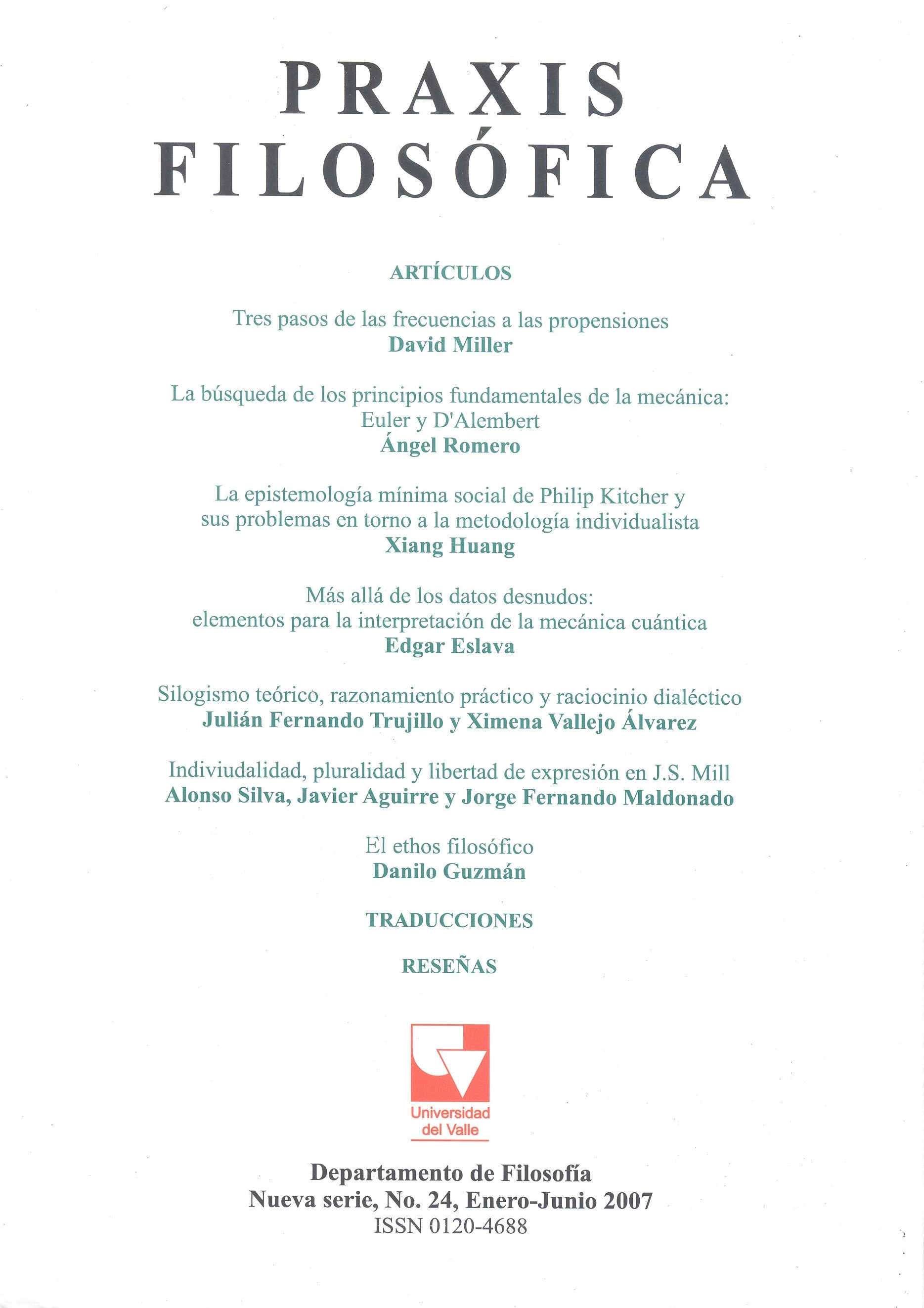
Más allá de los datos desnudos: elementos para la interpretación de la mecánica cuántica

Article Sidebar
Main Article Content
In an attempt to test the limits of the current interpretation of quantummechanics, according to which microscopic systems are always in asuperposition of states, A. Leggett has proposed the thesis of macrorealism,according to which quantum mechanical superpositions of macroscopicallydistinct states never occur. Leggett has also shown the basic features of someexperimental tests that would decide definitively between quantum mechanicsand macrorealism. In this paper I present some basic elements of the standard interpretation of quantum mechanics and of macrorealism, in order to makeevident that the experimental results may well be more open to interpretationthan Leggett himself would accept. Among such interpretations I highlightthe possibility of undertanding the results as examples of violations of theprinciple of induction in which macrorealism rests, opening the door for solvingthe tension between QM and macrorealism in terms of the backwards causatio,according to which there is no need for appealing to any special role playedby either observers or measurement apparatuses in order to explain whatdifferentiates quantum systems from macroscopic ones, a difference that couldnow be defined partly in terms of their causal and temporal directionality.
- Quantum mechanics
- interpretation
- Leggett
- macrorealism
- induction
- causation.
Eslava, E. (2007). Más allá de los datos desnudos: elementos para la interpretación de la mecánica cuántica. Praxis Filosófica, (24), 69–78. https://doi.org/10.25100/pfilosofica.v0i24.3134
Downloads
Download data is not yet available.





This work is licensed under a Creative Commons Attribution-NonCommercial-ShareAlike 4.0 International License.
De acuerdo con nuestra política (Licencia Creative Commons CC BY-NC-SA 4.0) los artículos presentados y sometidos al proceso editorial en la revista Praxis Filosófica no tienen costo alguno para sus autores ni retribuciones económicas para la revista. El artículo de carácter inédito, producto de investigación o de algún proyecto que se presente a Praxis Filosófica, no podrá estar sometido a otro proceso de publicación durante el proceso que se lleve en nuestra revista.