
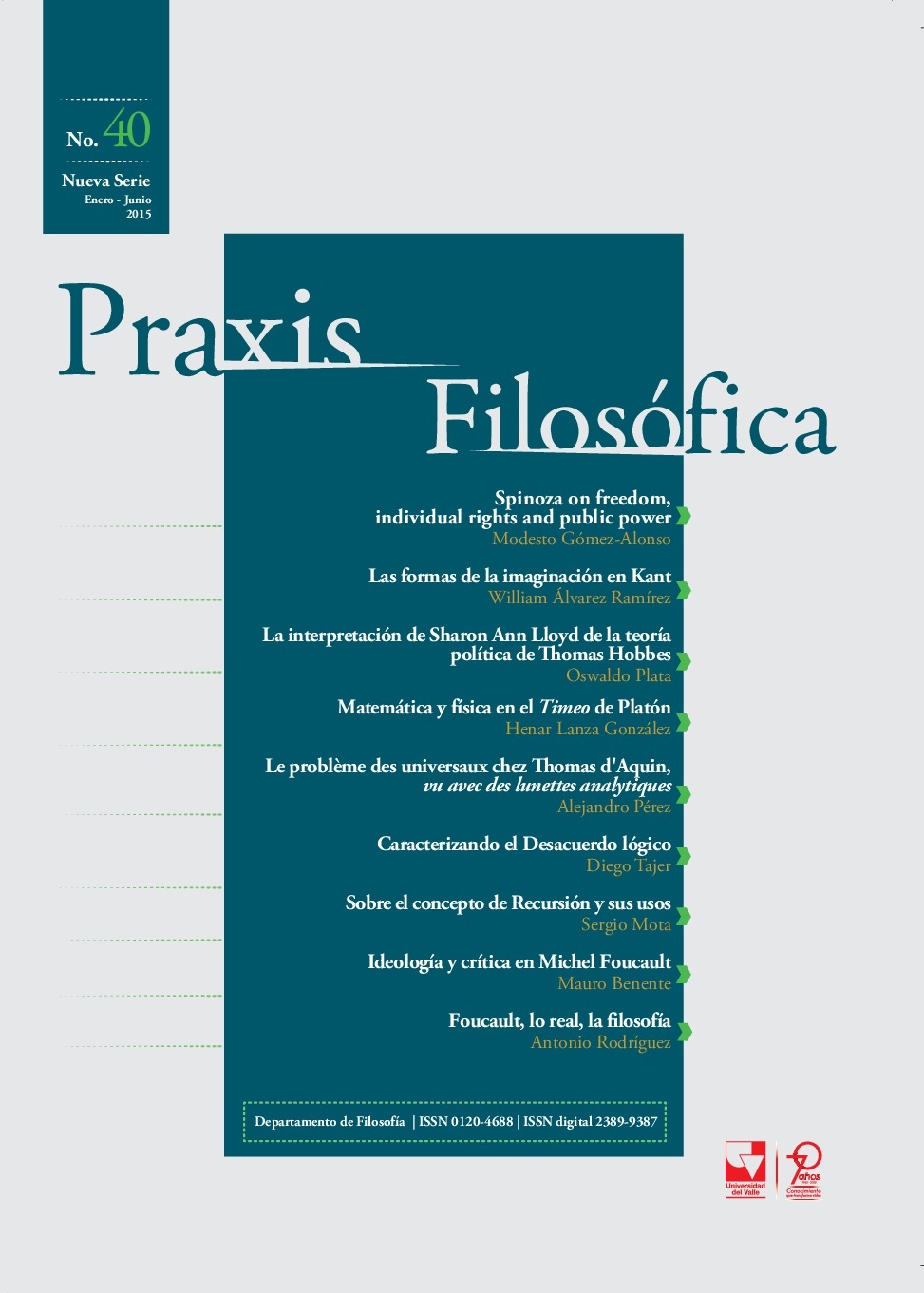
The intrepretation of Sharon Anne Lloyd Hobbes´s political theory (spanish version)

Article Sidebar
Main Article Content
In Ideals as Interests in Hobbes’s Leviathan, Sharon Ann Lloyd presents a novelty interpretation of Hobbes´s political theory problem and its solution. Thus, Lloyd aparts himself from the standard interpretation of Hobbes arguing that Hobbesian man is able to defend transcendent interests (i.e. interests that do not fit into self-preservation desire) and that the clash of transcendent interests is the main threat of the social order. Against the standard interpretation, Lloyd asserts that the conflict is not confined to the state of nature and that the Hobbes´s political theory is related to the problem of establishment and maintenance social order. According to Lloyd´s interpretation, the solution of social disorder is performed not only by means of realistic strategies (standard interpretation) but also by means of pedagogical strategies (social instruction process)
- Hobbes
- Social Contract.
- Lloyd
- Social Disorder
- Transcendent Interests
- Social Contract
Hampton, J. (1986). Hobbes and the Social Contract Tradition. Cambridge: Cambridge University Press.
Hobbes, T. (1994) Leviatán: La materia, forma y poder de un Estado eclesiástico y civil. Trad. Carlos Mellizo. Madrid: Alianza.
Kavka, G. (1983) “Hobbes’s War of All Against All”, Ethics, 93(2), pp. 291-310.
Lloyd, S. (1992). Ideals as Interests in Hobbes’s Leviathan. Cambridge: Cambridge University Press.
Lloyd, S. (2009). Morality in the Philosophy of Thomas Hobbes: Cases in the Law of Nature. Cambridge: Cambridge University Press.
Sprinborg, P. (1975) “Leviathan and the Problem Ecclesiastical Authority”, Political Theory, 3(3), pp. 289-303.
Downloads




De acuerdo con nuestra política (Licencia Creative Commons CC BY-NC-SA 4.0) los artículos presentados y sometidos al proceso editorial en la revista Praxis Filosófica no tienen costo alguno para sus autores ni retribuciones económicas para la revista. El artículo de carácter inédito, producto de investigación o de algún proyecto que se presente a Praxis Filosófica, no podrá estar sometido a otro proceso de publicación durante el proceso que se lleve en nuestra revista.